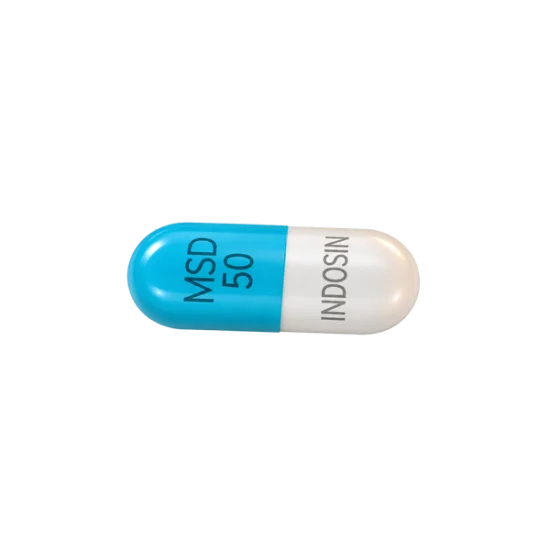
Indocin
4.3 (5 customer reviews)Taken by mouth as prescribed, Indocin contains indomethacin, a nonsteroidal anti-inflammatory drug used for painful inflammatory conditions such as acute gout, arthritis, bursitis, and tendinitis. It lowers prostaglandin production to reduce pain, swelling, and stiffness, while treatment is tailored to the diagnosis and individual risk factors.
Overview
Indocin contains indomethacin, also called indometacin in WHO and EMA terminology. It belongs to the NSAID group, short for nonsteroidal anti-inflammatory drugs, and is used when inflammation is contributing to pain, restricted movement, or joint swelling.
Indocin controls symptoms. It does not remove uric-acid deposits in gout or reverse structural joint damage caused by arthritis.
Indomethacin as the Active Ingredient
Indomethacin is a potent anti-inflammatory pain reliever. It is prescribed for inflammatory pain rather than routine everyday aches because its gastrointestinal, kidney, and cardiovascular risks need to be weighed against the expected benefit.
The WHO Collaborating Centre places indometacin within the Nonsteroidal Anti-inflammatory Agents category. The different spelling does not change the active substance.
NSAID Classification and Anti-inflammatory Effect
NSAIDs reduce the formation of prostaglandins, chemical messengers that contribute to pain, warmth, redness, and swelling after tissue irritation or joint inflammation. Lower prostaglandin activity can make movement easier during a gout flare or inflammatory arthritis episode.
Therapeutic indications
Indocin may be prescribed for acute gout flares, osteoarthritis, rheumatoid arthritis, ankylosing spondylitis, bursitis, tendinitis, and other painful inflammatory musculoskeletal conditions. It is not intended for every form of pain, and it is not a disease-modifying treatment for rheumatoid arthritis.
Its role depends on the diagnosis, age, kidney function, blood-pressure control, cardiovascular history, ulcer history, and other medicines. A prescriber may favor a short course for a flare or use it longer with periodic review when chronic inflammatory symptoms require it.
Acute Gout and Inflammatory Flares
For an acute gout attack, Indocin reduces the inflammation caused by monosodium urate crystals. It can ease swelling and pain, but it does not lower uric acid or dissolve existing crystal deposits.
The American College of Rheumatology identifies NSAIDs as one treatment option for gout flares, alongside colchicine and glucocorticoids, with the choice guided by comorbidities and prior response [2].
Arthritis and Musculoskeletal Inflammation
In osteoarthritis and inflammatory arthritis, Indocin can reduce pain that limits movement. It may also be used for inflammation around tendons or bursae, where swelling and pain worsen with activity.
Longer exposure brings more cumulative NSAID risk. Blood pressure, kidney function, fluid retention, and stomach symptoms deserve greater attention when treatment extends beyond a brief inflammatory episode.
How it affects the body
Indomethacin blocks the COX-1 and COX-2 enzymes. These enzymes help the body produce prostaglandins, so blocking them reduces inflammatory signaling and pain sensitivity.
COX-1 also supports the stomach lining, kidney blood flow, and platelet function. This explains why the same action that relieves pain can also cause indigestion, bleeding, fluid retention, or reduced kidney function in susceptible people [1].
COX Enzyme Inhibition
Indocin is a conventional NSAID rather than a selective COX-2 inhibitor. It affects both COX-1 and COX-2, which gives it strong anti-inflammatory activity but also makes stomach and kidney safety central to treatment decisions.
Reasons not to use it
Avoid combining Indocin with ibuprofen, naproxen, or other NSAIDs unless a prescriber has specifically directed it. Taking multiple NSAIDs increases the chance of ulcers, bleeding, kidney injury, and blood-pressure elevation.
Indomethacin can interact with anticoagulants and antiplatelet medicines by increasing bleeding risk. Corticosteroids can add further ulcer risk. Diuretics, ACE inhibitors, and angiotensin receptor blockers may increase kidney strain or reduce blood-pressure control when combined with an NSAID.
Lithium levels can rise with indomethacin, increasing the chance of toxicity. Methotrexate exposure may also increase. FDA safety information lists these interaction concerns and advises monitoring when clinically indicated [5].
When this is not for you
Indocin is not for you if you have had an allergic reaction to indomethacin, aspirin, or another NSAID; active gastrointestinal bleeding; a history of NSAID-triggered asthma; or pain related to coronary artery bypass graft surgery. Severe heart failure or advanced kidney disease also requires a prescriber-led decision rather than routine use.
Pregnancy needs special attention. NSAIDs used later in pregnancy can affect fetal kidney function, amniotic fluid volume, and fetal circulation, so Indocin should be used only when the treating clinician judges it appropriate.
Possible side effects
The most frequent adverse effects involve the digestive and nervous systems. Indigestion, nausea, abdominal discomfort, diarrhea, headache, dizziness, and drowsiness can occur, especially early in treatment or after dose increases.
Common Gastrointestinal and Nervous-System Effects
Mild stomach upset may settle when Indocin is taken with food. Dizziness or drowsiness can affect coordination, so avoid driving or using machinery until you know how the medicine affects you.
Headache can be confusing because Indocin may be used for pain while also causing headache in some people. A new severe headache, fainting, confusion, weakness on one side, or speech difficulty requires urgent medical evaluation.
Gastrointestinal Bleeding and Ulcer Risk
NSAIDs can damage the stomach or intestinal lining and may cause ulcers or bleeding without a long warning period. Risk is higher with older age, a previous ulcer or gastrointestinal bleed, heavy alcohol intake, corticosteroid treatment, anticoagulants, antiplatelet drugs, and prolonged NSAID use.
Black tar-like stools, vomiting blood, or vomit resembling coffee grounds are urgent warning signs. The American College of Gastroenterology describes upper gastrointestinal bleeding as a medical emergency requiring prompt assessment [4].
Cardiovascular, Kidney, Liver, and Allergic Reactions
Seek urgent help for chest pain, shortness of breath, sudden weakness, slurred speech, facial swelling, wheezing, or a blistering rash. These symptoms can signal serious cardiovascular, allergic, or severe skin reactions.
Reduced urination, rapid weight gain, new ankle swelling, or unusual fatigue may point to fluid retention or kidney problems. Yellowing of the skin or eyes, dark urine, and persistent nausea can indicate liver injury.
Formulation
Indocin contains indomethacin, also called indometacin in WHO and EMA terminology. It belongs to the NSAID group, short for nonsteroidal anti-inflammatory drugs, and is used when inflammation is contributing to pain, restricted movement, or joint swelling.
Indocin controls symptoms. It does not remove uric-acid deposits in gout or reverse structural joint damage caused by arthritis.
Indomethacin as the Active Ingredient
Indomethacin is a potent anti-inflammatory pain reliever. It is prescribed for inflammatory pain rather than routine everyday aches because its gastrointestinal, kidney, and cardiovascular risks need to be weighed against the expected benefit.
The WHO Collaborating Centre places indometacin within the Nonsteroidal Anti-inflammatory Agents category. The different spelling does not change the active substance.
NSAID Classification and Anti-inflammatory Effect
NSAIDs reduce the formation of prostaglandins, chemical messengers that contribute to pain, warmth, redness, and swelling after tissue irritation or joint inflammation. Lower prostaglandin activity can make movement easier during a gout flare or inflammatory arthritis episode.
Dosage and administration
- Route: Take Indocin by mouth exactly as prescribed.
- Dose: Use the prescribed amount in mg; the exact dose depends on the condition and individual risk factors.
- Frequency: Take it at the prescribed frequency; the number of doses per day depends on the condition.
- Timing: Take doses at the scheduled times. Taking Indocin with food may reduce nausea or upper-abdominal discomfort.
- Duration: Use it for the duration prescribed. Short courses may be used for inflammatory flares, while longer treatment requires periodic review.
- Missed dose: Take it when remembered unless the next dose is approaching. If the next dose is near, skip the missed dose and resume the usual schedule. Do not take two doses together.
- Other medicines: Do not add another anti-inflammatory painkiller for breakthrough symptoms without a medication review. NSAID treatment should be individualized because cardiovascular and gastrointestinal risks may increase with dose and duration [3].
Comparison
Indocin and an authorized generic indomethacin product contain the same active ingredient when the strength and oral formulation match. They are expected to provide the same therapeutic action, though inactive ingredients and appearance can differ.
A switch between oral formulations should be deliberate. Modified-release products, immediate-release products, and liquids are not automatically interchangeable dose for dose.
Active Ingredient and Expected Effect
Both options work through COX enzyme inhibition. Personal tolerability can differ if an inactive ingredient causes sensitivity or if the formulation changes how quickly the medicine is released.
Do not switch between strengths or formulations without confirmation from the prescribing clinician. The medicine name alone does not guarantee the same dosing schedule.
Common mistakes
Common Patient Mistakes
Common avoidable errors include:
- Taking ibuprofen, naproxen, or aspirin for added pain relief
- Continuing Indocin during dehydration from stomach illness
- Ignoring black stools, persistent stomach pain, or vomiting blood
- Reusing a prior prescription for a new type of pain
- Assuming ankle swelling is harmless after starting an NSAID
- Driving before knowing whether dizziness or drowsiness occurs
Do not wait for a routine appointment if severe abdominal pain, chest pain, shortness of breath, or signs of bleeding develop.
What doctors say
Doctor Perspectives
Physicians usually focus on risk assessment as much as pain intensity. A person with severe inflammation but a previous bleeding ulcer may need a different approach from someone with the same pain level and no gastrointestinal history.
Indocin can be useful for a defined inflammatory problem. It is a poor fit when a person has warning signs of bleeding, major kidney impairment, or an NSAID allergy.
Common questions
What should I do if I miss a dose of Indocin?
Take the missed dose when you remember, unless it is nearly time for the next scheduled dose. Skip it if the next dose is close, then continue with the normal schedule; do not take two doses together. FDA prescribing information, revised in 2021, warns that higher exposure increases the chance of NSAID adverse effects. If missed doses happen often, discuss a simpler timing plan with the prescribing clinician.
How does Indocin differ from ibuprofen?
Both Indocin and ibuprofen are NSAIDs that lower prostaglandin production, yet indomethacin is often selected for specific inflammatory conditions such as acute gout. Indocin may provide strong anti-inflammatory relief, but it also carries meaningful gastrointestinal, kidney, and cardiovascular risks. The 2025 WHO ATC/DDD Index lists both medicines among anti-inflammatory and antirheumatic products, though they are different active substances. Taking them together is not a routine way to improve pain control.
How long does one Indocin dose keep working?
The duration of symptom relief varies with the oral formulation, the inflammatory condition, kidney function, and the prescribed schedule. A single dose may reduce pain for several hours, while the anti-inflammatory response may build with continued scheduled treatment. FDA information published in 2021 advises using the prescribed regimen rather than taking extra doses when pain returns early. Recurrent breakthrough pain can mean the condition needs reassessment.
Does Indocin cause dizziness?
Yes. Dizziness, headache, and drowsiness are recognized adverse effects of indomethacin. MedlinePlus, reviewed by the U.S. National Library of Medicine in 2024, advises caution with driving and activities requiring alertness until the individual response is known. Severe dizziness with fainting, weakness, chest pain, or black stools needs urgent medical attention because those symptoms may signal a more serious problem.
Do you offer anonymous delivery?
Your order will be securely packed and shipped within 24 hours. This is exactly what your package will look like (images of an actual item sent). It has the size and look of a regular private letter (9.4x4.3x0.3 in.) and its contents cannot be seen.
Customer Feedback on Indocin
Sources
- FDA (2021). INDOCIN (indomethacin) Capsules: Prescribing Information.
- American College of Rheumatology (2020). 2020 American College of Rheumatology Guideline for the Management of Gout.
- FDA (2021). Nonsteroidal Anti-inflammatory Drugs: Drug Safety Communication.
- American College of Gastroenterology (2021). ACG Clinical Guideline: Upper Gastrointestinal and Ulcer Bleeding.
- U.S. National Library of Medicine (2024). Indomethacin: MedlinePlus Drug Information.