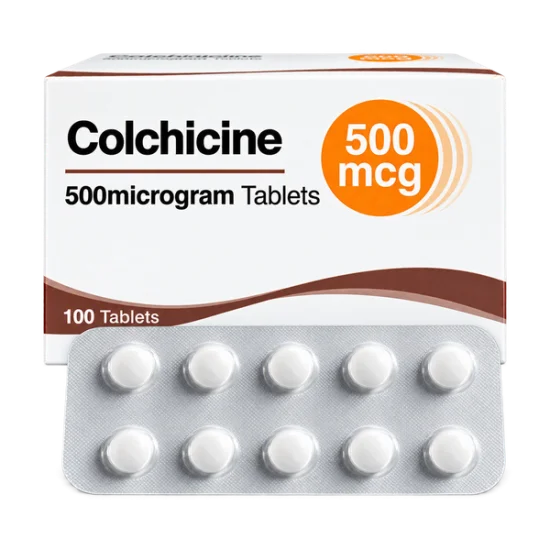
Colchicine
3.9 (4 customer reviews)Colchicine is used for gout flares and, in selected patients, to help prevent recurrent attacks. It reduces the immune reaction triggered by uric acid crystals, helping ease joint pain, warmth, swelling, and tenderness.
Overview
Colchicine, the active ingredient of Colchicine, is an anti-inflammatory alkaloid tablet used to treat gout flares and prevent recurrent attacks in selected patients. It reduces the immune reaction triggered by uric acid crystals in joints, helping ease pain, warmth, swelling, and tenderness without lowering uric acid itself.
Therapeutic indications
During an acute gout flare, uric acid crystals stimulate a powerful local immune response. Colchicine reduces neutrophil activity, which can limit swelling and shorten the inflammatory phase. It is used for gout attacks, yet it does not correct the elevated uric acid level that allowed crystals to form.
Colchicine may also be used to prevent recurrent gout flares and for familial Mediterranean fever, an inherited inflammatory condition marked by repeated fever and severe inflammation. Specialists may use it in selected cases of recurrent pericarditis, where inflammation affects the sac around the heart.
Its role changes with the condition. For gout, it calms crystal-driven inflammation. For familial Mediterranean fever, regular treatment reduces inflammatory episodes and lowers the long-term risk of amyloid protein buildup in organs. The World Health Organization includes colchicine on its Model List of Essential Medicines for familial Mediterranean fever [2].
The FDA describes colchicine as a medicine with a narrow therapeutic range, meaning that taking more than directed can rapidly raise toxicity risk [1].
How it affects the body
Colchicine is an anti-gout agent with a distinct role in inflammatory disease. It does not dissolve uric acid crystals or act as a conventional painkiller. Instead, it interrupts the movement and activation of neutrophils, immune cells that intensify inflammation after urate crystals form in a joint. This reduces the inflammatory cascade behind a typical gout attack.
Reasons not to use it
- severe kidney disease or dialysis;
- significant liver disease;
- existing blood disorders or unexplained low blood cell counts;
- neuromuscular disease;
- treatment with ciclosporin, clarithromycin, certain antifungals, or selected antivirals;
- pregnancy or breastfeeding, when the indication and treatment plan require individualized assessment.
Colchicine is not for you if you have had a serious allergy to colchicine or if you use a strong CYP3A4 or P-glycoprotein inhibitor while also having kidney or liver impairment. This combination can create dangerously high colchicine levels.
When this is not for you
Colchicine is not for you if you have had a serious allergy to colchicine or if you use a strong CYP3A4 or P-glycoprotein inhibitor while also having kidney or liver impairment. Older age does not automatically rule out Colchicine, yet reduced renal reserve and multiple medicines are common reasons for a lower or less frequent schedule. Alcohol can also worsen gout by raising uric acid and triggering dehydration, even though it does not create the same metabolic interaction as clarithromycin.
Possible side effects
Digestive effects are the most common limiting problem with Colchicine. Diarrhea, nausea, vomiting, abdominal cramping, and stomach pain can occur because rapidly dividing cells in the gut are sensitive to colchicine. These effects may appear early, and severe gastrointestinal symptoms warrant prompt medical advice rather than repeated dosing.
Rare reactions are more serious. Colchicine toxicity can suppress bone marrow, reduce blood cell counts, injure nerves and muscles, and contribute to rhabdomyolysis, a dangerous breakdown of muscle tissue. The risk rises with excessive dosing, reduced kidney function, reduced liver function, and interacting medicines. The European League Against Rheumatism highlights dose reduction and interaction review as central safeguards when colchicine is used for gout [3].
Seek urgent medical assessment for:
- severe or persistent diarrhea, vomiting, or abdominal pain;
- fever, sore throat, mouth ulcers, or unusual bruising;
- new muscle pain, profound weakness, tingling, or numbness;
- dark urine or markedly reduced urine output;
- extreme fatigue, paleness, or shortness of breath.
A mild loose stool may settle, but persistent symptoms deserve attention. Colchicine exposure can build up before a person recognizes the seriousness of the reaction.
Formulation
The tablets contain 500 micrograms of colchicine. This strength allows a prescriber to tailor treatment for the person’s kidney function, liver function, age, other medicines, and treatment purpose.
Dosage and administration
Colchicine is supplied here as oral 500 microgram tablets. Treatment schedules differ between acute gout, flare prevention, and inflammatory conditions, so there is no single amount that suits everyone.
Take Colchicine by mouth with water at the frequency prescribed for your indication. A clinician may set a lower schedule for older adults or for people with impaired kidney or liver function. The same caution applies when a person uses medicines that slow colchicine clearance.
- Swallow tablets whole with water.
- Take doses at consistent times when Colchicine is used regularly for prevention.
- Do not double a dose after forgetting one.
- If a dose is missed, take it when remembered unless the next planned dose is close.
- Resume the usual schedule after a missed dose rather than taking two doses together.
- Avoid changing the schedule during a flare without clinical direction.
Colchicine is not an all-purpose anti-inflammatory tablet. A dose used for a sudden flare may be different from a preventive schedule, and a long-term inflammatory condition may require another approach entirely.
Comparison
Colchicine treats inflammation around urate crystals. It does not lower serum uric acid over time. Urate-lowering treatment serves a different purpose: preventing new crystal formation and gradually reducing the body’s urate burden.
Allopurinol is usually a long-term strategy for people with recurrent gout, tophi, kidney stones, or persistently elevated uric acid. It is not designed to give immediate relief from a painful flare. Probenecid can be useful when kidney function is adequate and urinary stone risk is low, though it is less suitable for some people with kidney disease.
The American College of Rheumatology recommends anti-inflammatory prophylaxis, which may include colchicine, when urate-lowering therapy is started because changing urate levels can trigger early flares [4].
Common mistakes
Several avoidable errors account for poor tolerance or disappointing results with Colchicine.
- Taking additional tablets for persistent pain: this increases toxicity risk without reliably improving relief.
- Using it for every kind of joint pain: an infected joint, injury, rheumatoid arthritis, or calcium crystal arthritis needs different assessment and treatment.
- Ignoring diarrhea or vomiting: severe gastrointestinal symptoms can signal excessive colchicine exposure.
- Forgetting to mention antibiotics or antifungals: interaction risk can change within a single day after a new medicine begins.
- Stopping long-term urate management after one quiet month: gout crystals can remain in joints even when symptoms are absent.
- Assuming alcohol is harmless because it does not directly block colchicine metabolism: alcohol can still provoke gout through dehydration and increased uric acid production.
What doctors say
In clinical practice, physicians often stress that Colchicine is a precision medicine rather than a tablet to take freely whenever a joint hurts. The person’s indication, kidney function, liver function, and medication list determine the plan. A familiar gout flare may respond well when treatment begins promptly, but repeated attacks also signal that uric acid management needs attention.
Doctors also distinguish flare control from prevention. Colchicine can settle inflammatory activity, while long-term urate control often requires a separate strategy. For patients with frequent attacks, tracking flare dates, affected joints, alcohol intake, illness, and missed preventive treatment can reveal useful patterns.
Common questions
Can older adults use Colchicine?
Older adults can use Colchicine, though the treatment plan often needs more caution because kidney function may decline with age and medication interactions become more likely. The FDA prescribing information (2023) advises dose consideration in people with renal impairment and in those using interacting medicines. Age alone does not determine suitability. A clinician reviews kidney function, liver function, frailty, and the full medication list before setting a schedule.
Can you drink alcohol during Colchicine treatment?
Alcohol does not directly inhibit colchicine in the same way as clarithromycin or ciclosporin, but it may worsen gout risk by contributing to dehydration and increasing uric acid. NICE guidance on gout, updated in 2022, includes lifestyle measures as part of managing recurrent attacks [5]. During a flare, avoiding alcohol is often sensible because it can aggravate symptoms and make hydration harder. Heavy alcohol intake can also add strain in people with liver disease.
What should you do about Colchicine-related diarrhea?
Yes, diarrhea is one of the best-known side effects of Colchicine. The FDA lists gastrointestinal reactions, including diarrhea, nausea, vomiting, and abdominal pain, among the most common adverse effects (2023). Persistent diarrhea can lead to dehydration and may indicate excessive exposure, especially with abdominal pain or vomiting. Do not compensate for a missed dose or persistent symptoms by taking more tablets.
How long can Colchicine treatment continue?
The length of a Colchicine course depends on why it is prescribed. Acute gout treatment is usually short, while flare prevention or familial Mediterranean fever may involve regular longer-term use under a defined treatment plan. WHO guidance (2023) recognizes colchicine as an established therapy for familial Mediterranean fever. Long-term use is possible when the benefits outweigh risks and interactions, blood counts, muscle symptoms, kidney function, and liver function are considered.
Can you take Colchicine with food?
Colchicine may be taken with food or on an empty stomach. Food can be useful if the tablet causes mild nausea or stomach discomfort, though it does not prevent all digestive effects. The FDA prescribing information (2023) permits oral colchicine administration without a food requirement. Grapefruit and grapefruit juice should be avoided because they may raise colchicine exposure through CYP3A4 inhibition.
What is the best time of day to take Colchicine?
The best time depends on the prescribed schedule and the purpose of treatment. For regular prevention, choosing the same practical time each day can reduce missed doses. For a familiar acute gout flare, timing is tied to the treatment plan and early symptom recognition rather than a preferred clock time. The American College of Rheumatology guidance (2020) emphasizes matching anti-inflammatory treatment to the flare and the patient’s broader gout strategy.
Do you offer anonymous delivery?
Your order will be securely packed and shipped within 24 hours. This is exactly what your package will look like (images of an actual item sent). It has the size and look of a regular private letter (9.4x4.3x0.3 in.) and its contents cannot be seen.
Customer Feedback on Colchicine
Sources
- Food and Drug Administration (2023). COLCRYS (colchicine) tablets: Prescribing Information.
- World Health Organization (2023). WHO Model List of Essential Medicines.
- European League Against Rheumatism (2017). 2016 updated EULAR evidence-based recommendations for the management of gout.
- American College of Rheumatology (2020). 2020 American College of Rheumatology Guideline for the Management of Gout.
- National Institute for Health and Care Excellence (2022). Gout: diagnosis and management (NG219).