Skip to content
Save up to 80% Fast & Discrete Delivery
Accutane
Quality products
Fast & Discrete Delivery
Money-back guarantee

Accutane

3.4 (5 customer reviews)
Delivery: 4-7 business days
Payment
24/7 Support
Active ingredient: Isotretinoin

Free bonus tablets with every order: 4 on any order, 8 over $112.00, 12 over $222.88, 16 over $334.88

256-bit SSL
Certified pharmacy
Money-back guarantee

Adults and adolescents with severe nodular, cystic, inflammatory, or treatment-resistant acne may be prescribed Accutane, an oral isotretinoin capsule. It suppresses sebaceous gland activity, reducing excess oil, pore blockage, and inflammation that drive deep acne lesions. A supervised course can reduce new breakouts and help limit future scarring.

Overview

Accutane contains isotretinoin, a prescription oral retinoid used for severe acne that has not responded adequately to other treatment approaches.

A retinoid is a medicine related to vitamin A that changes how skin cells mature and how sebaceous glands function.

Isotretinoin Pharmacologic Class

Isotretinoin belongs to the retinoid class.

Therapeutic indications

A dermatologist may consider Accutane for:

  • Severe nodular acne with deep, tender lumps under the skin
  • Cystic acne that leaves dark marks or scars
  • Persistent inflammatory acne despite appropriate topical or oral treatment
  • Recalcitrant acne that repeatedly returns after prior therapy
  • Selected cases of moderate acne with substantial scarring risk or major psychosocial impact

Acne scarring is a reason to address active inflammation early. Accutane can reduce the risk of new scars by controlling new lesions, but it does not erase scars that have already formed.

A useful clinical distinction is lesion depth: a few surface pimples are managed differently from painful nodules that persist for weeks and leave scars.

The FDA prescribing information identifies severe recalcitrant nodular acne as its core indication [1].

How it affects the body

It works throughout the body rather than only on the skin surface, which is why it is reserved for substantial acne burden, painful lesions, or a high risk of permanent scarring.

Isotretinoin markedly reduces sebum production, decreases inflammatory acne lesions, and makes pores less likely to become blocked.

Its key clinical effect is shrinking overactive sebaceous glands, which lowers the oily environment that contributes to acne formation.

Reasons not to use it

This medication is not for you if you are pregnant, planning pregnancy without required prevention measures, or have a known hypersensitivity to isotretinoin or capsule ingredients. It also requires careful specialist assessment in people with significant liver disease, markedly elevated blood lipids, or major psychiatric concerns.

Do not combine Accutane with tetracycline antibiotics such as doxycycline or minocycline. This combination can increase the risk of intracranial hypertension, meaning raised pressure around the brain.

Tetracycline Antibiotics

Intracranial hypertension can cause severe headache, nausea, vomiting, and visual changes. These symptoms require urgent assessment.

Retinoids, Vitamin A, and Skin Products

Avoid vitamin A supplements and other systemic retinoids, including acitretin, unless specifically directed by the prescribing clinician. Combined vitamin A activity can raise toxicity risk.

When this is not for you

Accutane is not for anyone who is pregnant or may become pregnant without completing the required pregnancy-prevention process. Lowering the dose, taking supplements, or stopping late in pregnancy does not remove fetal risk.

If pregnancy is suspected or confirmed, stop Accutane immediately and contact the prescriber without delay.

Do not stop an essential antibiotic independently. Contact the prescriber managing the treatment so the regimen can be changed safely.

Bring a written list of every capsule, supplement, acne product, and protein or wellness powder to the appointment. Vitamin A exposure is often hidden in products people do not think of as medication.

The FDA’s iPLEDGE REMS program sets pregnancy-prevention requirements for isotretinoin in the United States [2].

Possible side effects

Dryness is the expected trade-off for reduced oil production. Chapped lips, dry facial skin, nasal dryness, dry eyes, sun sensitivity, and mild muscle or joint discomfort are common with isotretinoin .

Dry Skin, Lips, and Eyes

Useful measures include:

  • Apply a bland lip balm repeatedly, including before bed
  • Use fragrance-free moisturizer after gentle cleansing
  • Choose a mild, non-abrasive cleanser
  • Use preservative-free artificial tears if the eyes feel dry
  • Pause contact lens wear if lenses become uncomfortable
  • Avoid scrubs, peeling acids, harsh toners, and abrasive cleansing brushes
Keep lip balm in the places you already use daily: beside the toothbrush, in a work bag, and near the bed. Waiting until lips crack makes dryness harder to settle.

Do not pick cracked lips or peeling skin. Persistent eye pain, vision changes, severe headache, vomiting, or marked skin blistering needs urgent medical assessment.

Sun Sensitivity and Skin Protection

Isotretinoin can increase sun sensitivity. Use broad-spectrum sunscreen, reapply it during prolonged outdoor exposure, and protect the lips with a product that includes sun protection.

Sunscreen reduces exposure but does not make intense sun exposure risk-free. Tanning beds can also worsen irritation and dryness.

Serious Symptoms and Mood Changes

Mood changes, unusual sadness, agitation, loss of interest, or thoughts of self-harm need prompt reporting. A direct causal link between isotretinoin and depression remains debated, yet the FDA requires attention to psychiatric symptoms because severe acne itself can also affect mental health .

Severe abdominal pain, rectal bleeding, yellowing of the skin or eyes, dark urine, severe muscle weakness, or persistent headache with visual symptoms also require rapid medical review.
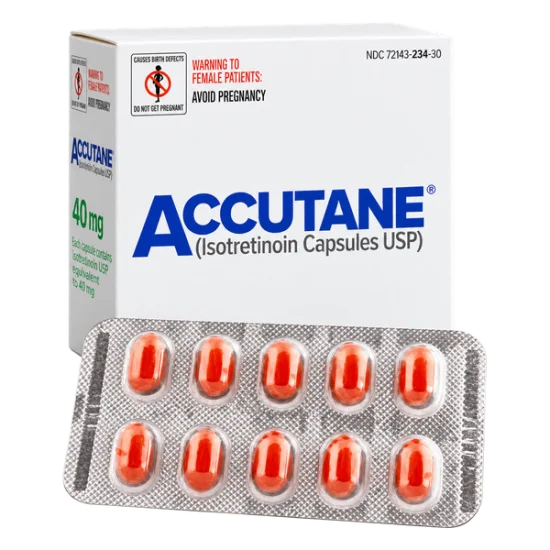
Formulation

Accutane contains isotretinoin, a prescription oral retinoid used for severe acne that has not responded adequately to other treatment approaches.

Dosage and administration

  • Dose: Take the prescribed isotretinoin capsule strength in mg; the weight-based daily dose and cumulative course dose are confirmed with a healthcare professional before starting.
  • Frequency: Take the capsules the prescribed number of times per day; do not change the frequency or take extra capsules.
  • Timing: Follow the food instructions for the prescribed capsule formulation, take doses at the scheduled time, and swallow capsules whole.
  • Duration: A typical course lasts about 4–6 months, with the duration adjusted according to treatment response, tolerance, and monitoring results.
  • Route: Take Accutane orally as capsules; it is not a topical treatment.
  • Missed dose: Skip a missed dose and take the next dose at the normal scheduled time. Do not double the next dose.
  • Monitoring: Attend the required monitoring for liver enzymes and blood lipids during treatment.

Comparison

Accutane is usually reserved for severe or treatment-resistant acne because it has a larger monitoring burden than standard topical therapy. It can offer durable improvement, though the dryness, pregnancy risk, and laboratory monitoring make it unsuitable as a first step for every person with acne.

Treatment approach Typical role Main limitation
Accutane oral isotretinoin Severe nodular, cystic, or recalcitrant acne Pregnancy prevention, monitoring, and systemic adverse effects
Topical retinoids such as tretinoin Mild to moderate comedonal or inflammatory acne Local irritation and slower response for deep nodules
Oral antibiotics such as doxycycline or minocycline Time-limited inflammatory acne control Antibiotic resistance concerns and no use with isotretinoin

Topical retinoids work mainly in the skin and are often used for milder disease. Oral antibiotics can reduce inflammation for limited periods but should be paired with an appropriate acne plan rather than continued indefinitely .

Generic isotretinoin contains the same active ingredient as Accutane. Formulation-specific food instructions and monitoring requirements still matter, so substitutions should be managed within the prescribing plan.

Common mistakes

Several avoidable errors can make treatment harder or less safe:

  • Doubling a missed dose
  • Taking vitamin A supplements without reporting them
  • Starting doxycycline or minocycline during treatment
  • Skipping blood tests or scheduled follow-up
  • Waxing, using strong peels, or aggressively exfoliating fragile skin
  • Ignoring a severe headache, visual symptoms, or mood changes
  • Sharing capsules with another person
  • Increasing alcohol intake while triglycerides or liver enzymes are being monitored

Waxing can remove more than hair during isotretinoin treatment. It can lift fragile skin and leave painful raw areas.

What doctors say

Accutane requires ongoing clinical oversight. A board-certified dermatologist typically reviews acne severity, prior treatments, medication history, alcohol intake, mental-health history, and medical conditions that can affect safety.

Doctors often observe that the best outcomes come from patients who report problems early rather than trying to push through severe symptoms. Dryness can usually be managed; a significant laboratory change or intense headache should not be ignored.

Doctor Perspectives

In clinical practice, dermatologists frame Accutane as a finite, closely followed course rather than a casual acne treatment. The goal is controlled cumulative exposure with manageable side effects and consistent monitoring.

Common questions

Does Accutane cause dry lips?

Yes. Dry, cracked lips are among the most common isotretinoin effects because the medicine strongly reduces oil production in the skin and mucous membranes. The FDA's 2023 prescribing information lists cheilitis, or inflamed dry lips, among expected adverse effects . Frequent use of a bland lip balm usually helps. Painful fissures, bleeding, or crusting that does not settle should be reported to the prescriber.

Can alcohol be used while taking Accutane?

Alcohol can add strain to the liver and may increase triglycerides, which are already monitored during isotretinoin treatment. The FDA's 2023 label advises caution because isotretinoin can affect lipid values and liver tests . Avoiding alcohol is the lowest-risk choice during a course. A clinician can give individualized guidance when alcohol use, liver disease, or abnormal laboratory results are relevant.

What should I do after a missed Accutane dose?

Skip the missed capsule and take the next dose at the usual scheduled time. Do not take two capsules together or take extra capsules the following day. The FDA's 2023 prescribing information warns against doubling doses because isotretinoin exposure should remain within the prescribed plan . Repeated missed doses should be discussed at follow-up because they can affect the intended cumulative course.

How long does an Accutane course last, and is long-term use acceptable?

Many courses last around four to six months, though duration changes with the prescribed regimen, response, interruptions, and tolerability. The American Academy of Dermatology’s 2024 acne guideline supports isotretinoin for severe or treatment-resistant acne under clinician supervision . Accutane is designed as a defined treatment course rather than indefinite maintenance therapy. A relapse after completion needs reassessment before any further course is considered.

Does pregnancy rule out Accutane treatment?

Yes. Pregnancy rules out Accutane because isotretinoin can cause severe birth defects and pregnancy loss. The FDA's 2023 iPLEDGE REMS requires pregnancy-prevention measures and testing for patients with reproductive potential . Stop the capsules immediately after suspected pregnancy and contact the prescriber. This warning applies even to short exposure.

Can people under 18 use Accutane?

Accutane may be prescribed to adolescents with severe, scarring, nodular, or treatment-resistant acne when a dermatologist judges that the benefit outweighs the risks. The FDA's 2023 labeling includes monitoring considerations for younger patients, including musculoskeletal symptoms and mental-health changes . Parents or guardians may be involved in monitoring, iPLEDGE requirements, and follow-up planning. Age alone does not determine suitability; acne severity and safety factors do.

How soon does Accutane become noticeable?

Oiliness and dryness may appear before visible acne improvement. Some people experience an initial flare, while deeper inflammatory lesions often reduce gradually during the course. The American Academy of Dermatology's 2024 guideline describes isotretinoin as a treatment for severe acne rather than a rapid spot treatment . Painful worsening, extensive inflammation, or sudden severe symptoms should be reported instead of waiting for the next routine appointment.

Do you offer anonymous delivery?

Your order will be securely packed and shipped within 24 hours. This is exactly what your package will look like (images of an actual item sent). It has the size and look of a regular private letter (9.4x4.3x0.3 in.) and its contents cannot be seen.

Customer Feedback on Accutane

Tracey, 64
Sacramento
Verified
Rating: 3 out of 5
I used Accutane for stubborn deep breakouts that had continued well into adulthood. My skin started feeling less oily after the first month, and the painful lesions gradually became less frequent. Dry lips were inconvenient, but the improvement in the deeper acne made the course feel worthwhile.
Nov 3, 2026
Karen, 46
Miami
Verified
Rating: 4 out of 5
I completed my prescribed course after years of recurring cystic acne along my jawline. By the later months, I was waking up without new painful bumps, and the change was visible in photos. I felt satisfied with how steadily my skin cleared.
Nov 9, 2026
Susan, 40
Chicago
Verified
Rating: 4 out of 5
My acne had kept returning after other treatments, mostly on my cheeks and chin. Accutane reduced the deep lesions over the course, and my skin stayed much calmer after finishing. I was pleased that I no longer had to plan around weekly flare-ups.
Oct 12, 2026
Jessica, 42
Columbus
Verified
Rating: 2 out of 5
I stopped the course after developing headaches and feeling increasingly unwell. The breakouts had not improved enough for me before that point, and my dermatologist decided the treatment should not continue. It was disappointing, but stopping was the right decision for me.
Oct 26, 2026
Louise, 57
Charlotte
Verified
Rating: 4 out of 5
I took Accutane for persistent inflammatory acne that had left marks for years. The new breakouts became less frequent and much less painful as the course progressed. I was relieved to see my skin settle after so many unsuccessful routines.
Oct 31, 2026

Sources

  1. FDA (2023). Isotretinoin Capsules Prescribing Information
  2. FDA (2023). iPLEDGE Risk Evaluation and Mitigation Strategy for Isotretinoin Products
Get our free app Shop faster and track your orders 4.0 · 266 reviews Install