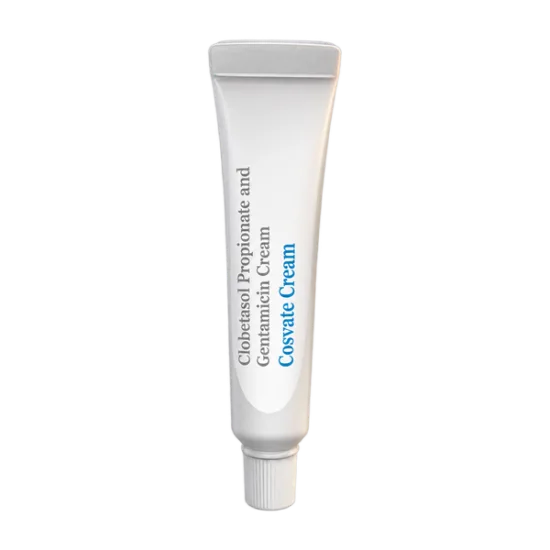
Cosvate cream
4.3 (4 customer reviews)By calming overactive inflammatory signals in the skin, clobetasol in Cosvate cream reduces redness, swelling, itching, and scaling. It is applied only to affected skin under a clinician-directed treatment plan.
Overview
Cosvate cream is a topical corticosteroid containing clobetasol propionate 0.05% w/w. Clobetasol is one of the more potent corticosteroids used on the skin, so it is intended for defined inflammatory flare-ups rather than daily moisturizing or long-term routine skin care.
Therapeutic indications
Clinicians may prescribe Cosvate cream when inflammation is prominent and a milder topical treatment has not controlled the flare. Relief may include reduced itching, less visible redness, softer plaques, and less scaling. The speed and degree of improvement vary with the diagnosis, severity, body site, and whether an infection is also present.
Common inflammatory conditions for which clobetasol may be used include:
A potent corticosteroid can make inflamed skin look calmer while an infection remains active underneath. A rash with pus, crusting, increasing pain, expanding borders, or fever needs clinical assessment rather than repeated steroid application.
How it affects the body
Corticosteroids reduce the activity of inflammatory chemical messengers released in irritated skin. This decreases dilation of tiny blood vessels, fluid movement into tissues, immune-cell activity, and the itch cycle that can lead to repeated scratching.
Reasons not to use it
Cosvate cream is not for you if you have had an allergic reaction to clobetasol propionate or another component of the cream. It should not be used on untreated bacterial, fungal, viral, or parasitic skin infections unless a clinician has specifically included appropriate treatment for the infection.
Do not apply Cosvate cream to:
- Open wounds or ulcerated skin
- Burns
- Acne lesions or rosacea
- Eyes, eyelids, lips, mouth, or other mucous membranes
- Areas affected by untreated cold sores, chickenpox, shingles, or fungal infection
- Large skin areas without a defined treatment plan
When this is not for you
The face, groin, armpits, skin folds, and genital skin absorb topical corticosteroids more easily than thicker skin on the palms or soles. Children also have a larger skin-surface-area-to-body-weight ratio, which can increase systemic absorption. The European Medicines Agency advises careful use of potent topical corticosteroids because local and systemic adverse effects rise with extended use, occlusion, and application to thin skin [2].
Pregnancy and breastfeeding need individualized clinical advice. Avoid applying clobetasol to the breast area when breastfeeding because an infant could ingest cream residue during feeding.
Possible side effects
Most short, directed courses are tolerated without major problems. Mild burning, stinging, dryness, or irritation can occur soon after application, especially on cracked or inflamed skin. These effects should settle rather than intensify.
Possible local adverse effects include:
- Burning, stinging, itching, or dryness
- Folliculitis, meaning inflamed hair follicles
- Acne-like bumps
- Skin thinning or easy bruising
- Stretch marks
- Visible small blood vessels
- Changes in skin color
- Excess hair growth at the application site
Longer use, thick layers, occlusive coverings, and treatment of large areas increase the risk of absorption beyond the skin. Excessive systemic corticosteroid exposure may suppress normal adrenal hormone production, though this is uncommon with correctly limited topical treatment. The FDA label warns that potent topical corticosteroids can produce reversible hypothalamic-pituitary-adrenal axis suppression when used excessively or under occlusion [3].
Vision changes need prompt assessment. Blurred vision, eye pain, halos around lights, or facial use near the eyes should not be ignored.
Formulation
Clobetasol propionate is the active corticosteroid in Cosvate cream. The 0.05% w/w concentration means that each measured amount of cream contains 0.05% clobetasol by weight; the remaining cream base allows the medicine to spread across the affected skin.
Corticosteroids reduce the activity of inflammatory chemical messengers released in irritated skin. This decreases dilation of tiny blood vessels, fluid movement into tissues, immune-cell activity, and the itch cycle that can lead to repeated scratching. The FDA describes clobetasol propionate as a super-high-potency topical corticosteroid for short-term use in corticosteroid-responsive dermatoses [1].
The cream base is not the treatment itself. Clobetasol is the component that suppresses inflammation.
Dosage and administration
Cosvate cream is used in a thin film over the affected area at the frequency and for the treatment period directed by the prescriber. The regimen for the chosen strength is confirmed with a healthcare professional before starting. Clobetasol is generally reserved for limited areas and short courses because prolonged exposure increases the risk of steroid-related skin changes.
A practical application routine is:
- Wash and dry the affected skin gently.
- Apply a small amount in a thin, even layer over the inflamed area only.
- Rub in lightly until the cream disappears.
- Wash hands after application unless the hands are being treated.
- Avoid covering the area with airtight dressings unless this was specifically directed.
A fingertip unit can help estimate cream quantities: one fingertip unit is the amount squeezed from an adult fingertip to the first crease. The right amount still depends on the body area and diagnosis. Larger areas do not automatically mean that stronger or more frequent use is appropriate.
If an application is missed, apply it when remembered unless the next planned application is close. Do not apply an extra layer to make up for it.
Comparison
Cosvate cream is a topical, single-ingredient corticosteroid containing clobetasol propionate 0.05% w/w. It differs from milder topical corticosteroids by providing stronger anti-inflammatory action for defined flare-ups, while remaining unsuitable for routine moisturizing or prolonged daily skin care.
Common mistakes
- Applying cream to every itchy area rather than diagnosed lesions
- Continuing past the planned treatment period because the cream initially helped
- Using it on acne, ringworm, cold sores, or an undiagnosed rash
- Covering treated skin with plastic wrap, tight bandages, or airtight clothing
- Sharing the tube with another person who has a different rash
- Applying extra cream after a missed application
- Using it near the eyes without explicit clinical direction
One frequent mistake is treating ring-shaped scaling lesions as eczema. Clobetasol may reduce itching at first, while a fungal infection continues to expand at the border.
What doctors say
Dermatology practice focuses on matching potency to the body site and diagnosis. Thick plaques on areas such as elbows or knees may need a stronger anti-inflammatory approach than thin facial skin. Clinicians also assess whether a rash is eczema, psoriasis, contact dermatitis, fungal infection, or bacterial infection before selecting clobetasol.
A clinician may reassess treatment if symptoms do not begin to settle, return rapidly after stopping, or spread beyond the initial area. The American Academy of Dermatology emphasizes that topical corticosteroid selection should consider disease severity, body site, patient age, and duration of use [4].
Common questions
Can Cosvate cream be used during pregnancy or breastfeeding?
Clobetasol is a potent topical corticosteroid, so pregnancy use should be limited to situations where a clinician considers the expected benefit appropriate. The FDA’s 2020 clobetasol prescribing information advises caution because systemic absorption can occur, especially with extensive use, damaged skin, or occlusive coverings [5]. During breastfeeding, cream should not be applied to the nipple or surrounding breast skin before feeding. A clinician can select the lowest necessary exposure and the safest treatment area.
What should I do if Cosvate cream does not produce the expected result?
Do not extend treatment on your own simply because the rash remains visible. Eczema, psoriasis, allergic contact dermatitis, bacterial infection, and fungal infection can resemble one another, yet they require different management. The WHO’s 2021 guidance recognizes that correct diagnosis is central to managing skin conditions and preventing inappropriate treatment escalation. Worsening redness, pain, pus, or expansion beyond the original area needs clinical review.
How long does one application of Cosvate cream keep working?
Clobetasol begins reducing inflammatory signaling after it is absorbed into the skin, but visible improvement depends on the condition, site, and severity. Its anti-inflammatory effect is not a reason to apply more frequently than directed, because the medicine can remain active in the skin after application. The FDA’s 2021 prescribing information describes clobetasol as a high-potency topical corticosteroid intended for limited treatment courses rather than continuous maintenance use. Apply each dose according to the prescribed schedule.
What should I do after a missed application of Cosvate cream?
Apply the missed dose when remembered, provided it is not nearly time for the next planned application. Do not use a double amount or apply a thicker layer. The European Medicines Agency’s 2019 guidance advises using corticosteroid medicines in the lowest amount needed for the shortest appropriate period, which helps limit unwanted absorption and skin changes. A single missed application is usually less risky than compensating with excess cream.
Which diet, exercise, or habits can help or hinder the result?
Food and exercise do not directly change clobetasol’s action in the skin. For eczema, gentle fragrance-free cleansing, regular moisturizing away from the application time, and avoiding known irritants such as harsh detergents can reduce triggers that keep the skin inflamed. A consistent routine can also reduce scratching and friction. For psoriasis, stress management, avoiding skin injury from scratching, and following a clinician’s broader care plan may help reduce flares. The American Academy of Dermatology’s 2014 guideline notes that topical treatment works best when it is part of a condition-specific skin-care routine rather than the only measure used.
Do you offer anonymous delivery?
Your order will be securely packed and shipped within 24 hours. This is exactly what your package will look like (images of an actual item sent). It has the size and look of a regular private letter (9.4x4.3x0.3 in.) and its contents cannot be seen.
Cream and Ointment Formulation Differences
Cosvate cream is designed for application to affected skin where a lighter, spreadable texture is useful. Creams are often preferred for moist, weeping, or hairy areas because they feel less greasy and are easier to distribute in hair-bearing skin.
The active drug may be the same across topical corticosteroid formulations, yet the base can change how the product feels and how strongly it hydrates the outer skin layer. Use Cosvate cream as the prescribed formulation rather than substituting application habits from an ointment.
Stopping Cosvate and Seeking Medical Advice
Stop using Cosvate cream and seek medical advice if the area becomes markedly more painful, swollen, blistered, or infected-looking. A spreading rash, pus, fever, facial swelling, hives, or breathing difficulty requires prompt medical attention.
Accidental eye exposure should be managed by rinsing the eye gently with clean running water. Persistent redness, pain, blurred vision, or light sensitivity after exposure needs urgent evaluation.
Treatment that does not produce the expected result may mean the diagnosis needs reconsideration. It can also indicate infection, allergic contact dermatitis, incorrect application, or a condition requiring a different treatment approach. Do not keep extending potent steroid treatment without a clinician-directed plan.
Customer Feedback on Cosvate cream
Sources
- FDA Food and Drug Administration (2021). Clobetasol Propionate Cream USP, 0.05% Prescribing Information.
- EMA (2020). Summary of Product Characteristics (SmPC) — clobetasol propionate
- DailyMed, U.S. National Library of Medicine (2024). Clobetasol Propionate Cream: Drug Label Information.
- Journal of the American Academy of Dermatology (2014). Guidelines of Care for the Management of Atopic Dermatitis: Section 2. Management and Treatment with Topical Therapies.
- FDA Food and Drug Administration (2020). Temovate (Clobetasol Propionate) Cream Prescribing Information.