Clomid
4 (3 customer reviews)Taken by mouth as tablets during a planned treatment cycle, Clomid contains clomiphene citrate and is used to induce ovulation in selected people with ovulatory infertility. It supports the brain-to-ovary hormone signals needed for follicle development and egg release.
Overview
Clomid tablets contain clomiphene citrate, also called clomiphene or clomifene. It is an oral fertility medication used for ovulation induction when ovulation is absent or irregular. FDA prescribing information identifies clomiphene citrate as a selective estrogen receptor modulator for women with ovulatory dysfunction who want to conceive [1].
Therapeutic indications
Clomid may be considered for women with irregular ovulation, absent ovulation, or selected forms of ovulatory dysfunction. It is often used in fertility treatment when menstrual cycles are infrequent or unpredictable.
People with polycystic ovary syndrome, also called PCOS, may have irregular ovulation because hormonal signaling prevents follicles from maturing normally. PCOS can be an indication for Clomid, yet it does not make Clomid the preferred choice for every patient.
A fertility specialist may assess:
- menstrual-cycle pattern and evidence of ovulation;
- ovarian reserve and age-related reproductive factors;
- tubal patency, meaning whether the fallopian tubes are open;
- semen analysis for the male partner;
- thyroid, prolactin, adrenal, or metabolic conditions;
- previous pregnancy history and prior fertility treatment.
Unexplained infertility needs the same structured evaluation. A normal ovulation response does not remove barriers related to sperm quality, egg quality, tubal function, embryo development, or implantation.
How it affects the body
Clomid changes how the hypothalamus and pituitary gland respond to estrogen feedback. The hypothalamus is the brain area that coordinates reproductive hormone signals. The pituitary gland releases follicle-stimulating hormone and luteinizing hormone, which guide ovarian follicle growth.
A follicle is a small fluid-filled ovarian structure containing an immature egg. Ovulation is the release of a mature egg from that follicle.
When clomiphene blocks some estrogen receptors in the brain, the body perceives lower estrogen activity. This can increase follicle-stimulating hormone and luteinizing hormone release, encouraging follicle development and, in responsive cycles, ovulation. Clomid does not directly force an egg to release.
Response varies between patients. Dose escalation is not self-directed.
The American Society for Reproductive Medicine describes ovulation induction as a treatment that should be matched to the cause of infertility, ovarian function, and reproductive goals [2].
Reasons not to use it
- already pregnant;
- unexplained abnormal uterine bleeding;
- active liver disease;
- an ovarian cyst not related to PCOS;
- uncontrolled thyroid or adrenal disease;
- a prior serious reaction to clomiphene;
- infertility that has not been evaluated;
- tubal blockage, severe male-factor infertility, or a condition affecting ovarian reserve.
When this is not for you
This medication is not for you if you are already pregnant, have unexplained abnormal uterine bleeding, active liver disease, an ovarian cyst not related to PCOS, uncontrolled thyroid or adrenal disease, or a prior serious reaction to clomiphene.
PCOS itself does not rule out Clomid. Ovarian enlargement, persistent cysts, or marked pelvic symptoms can change the treatment decision.
Use requires clinician-directed fertility care. Before another cycle, report new vision changes, severe headaches, abdominal pain, unusual swelling, or substantial mood symptoms.
Possible side effects
Most people tolerate a prescribed Clomid course without severe effects. Common adverse effects include hot flashes, headache, nausea, breast discomfort, bloating, mood changes, dizziness, and pelvic discomfort.
Some symptoms need prompt medical attention:
- visual blurring, flashes, spots, or double vision;
- severe pelvic or abdominal pain;
- marked abdominal swelling;
- rapid weight gain;
- shortness of breath;
- reduced urination;
- heavy or unusual vaginal bleeding.
Visual symptoms deserve special attention. Clomiphene-related vision changes may worsen with continued exposure, so further doses should not be taken until the prescriber has advised on the next step.
Ovarian hyperstimulation syndrome involves enlarged ovaries and fluid shifts in the body. It is less frequent with oral ovulation-induction medicines than with injectable gonadotropins, though severe pain, swelling, breathlessness, or reduced urine output still require urgent assessment.
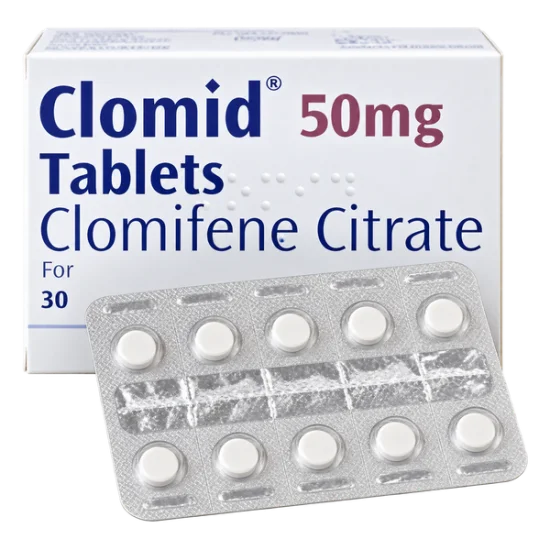
Formulation
Clomid tablets contain clomiphene citrate, also called clomiphene or clomifene. It is an oral fertility medication used for ovulation induction when ovulation is absent or irregular. FDA prescribing information identifies clomiphene citrate as a selective estrogen receptor modulator for women with ovulatory dysfunction who want to conceive [1].
Clomid treats an ovulation problem, not every cause of infertility. Blocked fallopian tubes, severe sperm-factor infertility, untreated thyroid disease, and diminished ovarian reserve need different assessment and treatment pathways.
Dosage and administration
- Dose: Take the prescribed amount of Clomid tablets. The product is marked 50 mg, but the appropriate dose varies between strengths and users, so there is no single amount for everyone.
- Frequency: Take the tablets once each day at the same time during the prescribed course.
- Timing: Take the tablets at the planned time of day; the available information does not specify whether they should be taken before or after meals.
- Duration: Take Clomid only for the defined course during the planned treatment cycle. Do not extend the course or take extra tablets after a negative ovulation test.
- Route: Take the tablets by mouth.
Comparison
Clomid remains an oral option for selected ovulatory infertility, though fertility care is individualized. Letrozole is frequently considered for ovulation induction in PCOS, while gonadotropins and IVF are used in different clinical settings.
Gonadotropins directly stimulate the ovaries and need closer ultrasound and hormone monitoring because ovarian hyperstimulation and multiple pregnancy are more likely. IVF, or in vitro fertilization, involves retrieving eggs, fertilizing them in a laboratory, and transferring an embryo to the uterus.
NICE fertility guidance places treatment selection within a broader assessment of ovulation, tubal status, semen findings, age, and prior treatment response [3].
Common mistakes
Common Patient Mistakes and Misconceptions
A treatment cycle is not continuous daily therapy. Leftover tablets should not be carried into a later cycle without a new plan.
Some patients assume a negative home ovulation test means they should increase the dose. Others continue despite blurred vision or severe pelvic symptoms. Both actions can create avoidable risk.
Clomid also does not guarantee pregnancy after ovulation. A confirmed ovulation response is useful information, yet it may reveal the need to investigate sperm, tubes, egg reserve, or uterine factors more closely.
What doctors say
In clinical fertility care, Clomid is valued because it is an oral treatment that can induce ovulation without injectable medication for suitable patients. It can be a practical starting option when evaluation points to ovulatory dysfunction.
Specialists reassess repeated unsuccessful cycles rather than simply increasing treatment intensity. They review whether ovulation occurred, whether intercourse or insemination timing was appropriate, and whether a different diagnosis or treatment route better fits the situation.
WHO fertility guidance emphasizes that infertility care should address both female and male factors rather than focusing only on ovulation [4].
Common questions
Can Clomid be taken with food or on an empty stomach?
Clomid may generally be taken with or without food, unless the prescriber has given a cycle-specific instruction. Taking it with a small meal can be useful for people who experience nausea. Food does not replace the need to take each dose on the planned day of the fertility cycle. FDA prescribing information published in 2012 supports oral administration of clomiphene tablets.
Can Clomid be used during pregnancy or breastfeeding?
Clomid is not used during pregnancy because its purpose is to induce ovulation before conception occurs. Pregnancy testing may be used when clinically appropriate before starting another cycle. Breastfeeding requires an individualized medical decision because clomiphene may affect lactation and treatment timing. WHO fertility guidance from 2025 supports pre-treatment assessment before fertility medicines are used.
What is the best time of day to take Clomid?
The best time is a consistent time that fits the prescribed cycle schedule. Morning or evening can both work when the dose is taken once daily as directed. Some patients prefer evening if hot flashes or nausea are inconvenient, though changing timing should not alter the prescribed treatment days. The 2012 FDA labeling does not require a special time of day for oral clomiphene administration.
How soon can Clomid’s effect become noticeable?
The relevant effect is ovulation, which may occur after the prescribed tablet course and varies by cycle response. Hot flashes, headache, or pelvic sensations can appear earlier, though symptoms do not reliably prove ovulation. Clinicians may confirm response through ultrasound, progesterone testing, or cycle assessment rather than symptoms alone. ASRM guidance published in 2023 supports individualized assessment of ovulation-induction response.
Can Clomid tablets be split, crushed, or chewed?
Swallow Clomid tablets whole unless the prescriber has specifically instructed otherwise. Splitting, crushing, or chewing can make it harder to follow the intended dose accurately, especially when treatment is limited to selected cycle days. A clinician can advise if a different tablet arrangement is appropriate for the prescribed regimen. The 2012 FDA labeling identifies Clomid as an oral tablet formulation containing clomiphene citrate.
Do you offer anonymous delivery?
Your order will be securely packed and shipped within 24 hours. This is exactly what your package will look like (images of an actual item sent). It has the size and look of a regular private letter (9.4x4.3x0.3 in.) and its contents cannot be seen.
Customer Feedback on Clomid
Sources
- FDA (2012). Clomid (clomiphene citrate) tablets prescribing information.
- American Society for Reproductive Medicine (2023). Recommendations from the 2023 International Evidence-based Guideline for the Assessment and Management of Polycystic Ovary Syndrome.
- NICE (2013). Fertility problems: assessment and treatment.
- WHO (2025). Guideline for the prevention, diagnosis and treatment of infertility.